
Steel Detailing Productivity with bocad: Reduce Rework and Save Time
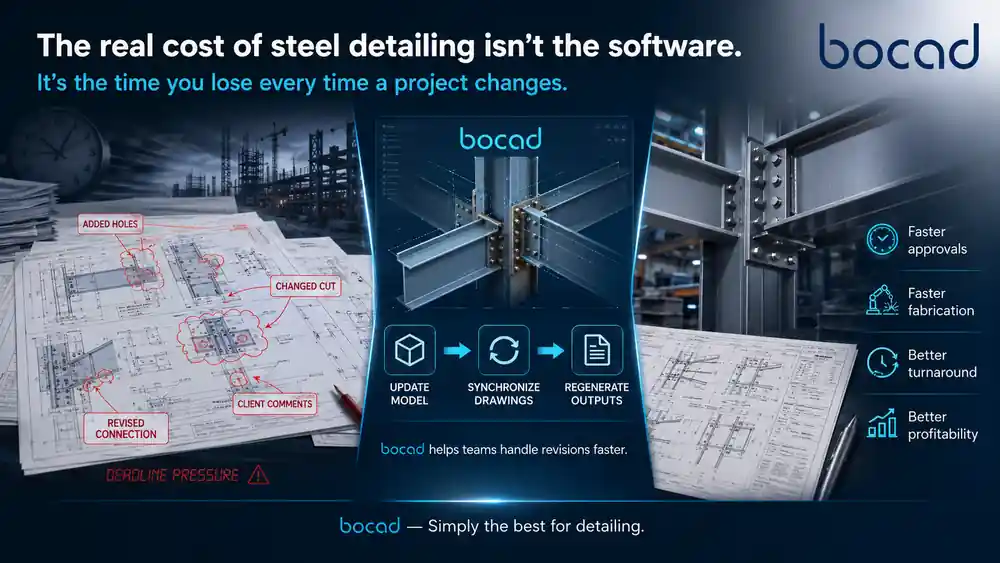
The real cost of steel detailing is not the software.
It is the time you lose every time a project changes.
And everyone in this industry knows one thing: no steel project ever goes exactly as planned.
A few holes get added.
A cut changes.
Connections get revised.
Client comments arrive at the last minute.
Design updates keep coming till fabrication.
That is the reality of structural steel projects.
This is why Steel Detailing Productivity has become a serious priority for fabricators, steel detailing companies, and engineering teams that want to stay competitive in today’s fast-moving construction environment.
The companies that survive in today’s market are not necessarily the biggest. They are the ones that can adapt faster, respond to changes quicker, and keep the project moving without unnecessary delays.
That is exactly why more fabricators and detailing companies are now starting to seriously evaluate different workflows and technologies instead of simply continuing with “what we have always used.”
Why Steel Detailing Productivity Matters Today
Steel detailing is not just about creating drawings. It directly affects approvals, fabrication, delivery schedules, site coordination, and overall project turnaround.
When the detailing workflow slows down, the impact is not limited to the detailing team alone. It can affect the complete project chain.
Faster detailing means:
- Faster approvals
- Faster fabrication
- Faster deliveries
- Better project turnaround
- Better profitability
In this environment, every saved man-hour matters.
Year after year, the participation at NASCC: The Steel Conference keeps growing. That shows how active and competitive the structural steel industry has become.
Demand is growing.
Competition is growing.
Pressure on timelines is growing.
So, Steel Detailing Productivity is no longer just an internal efficiency topic. It has become a business advantage.
| Project Challenge | Impact on Steel Detailing Workflow | How bocad Helps |
|---|---|---|
| Last-minute design changes | Drawings need to be revised repeatedly | Helps teams handle modifications more efficiently |
| Added holes or cut changes | Manual updates can consume extra detailing time | Supports faster drawing regeneration |
| Revised connections | Existing shop drawings may need correction | Makes revision handling more practical |
| Late client comments | Approval cycles may get delayed | Helps detailing teams respond faster |
| Frequent design updates till fabrication | Rework increases and schedules become difficult to control | Reduces unnecessary rework during execution |
| Tight project timelines | Every lost man-hour affects delivery | Improves steel detailing productivity |
| Fabrication pressure | Delayed drawings can delay production | Supports faster fabrication readiness |
| Competitive market demand | Companies need faster project turnaround | Helps improve delivery confidence and schedule control |
A detailing team that can manage revisions faster can support faster approvals. A fabrication company that receives updated drawings faster can move production forward with more confidence. A project team that reduces rework can protect timelines and improve profitability.
The Real Challenge: Project Changes and Revisions
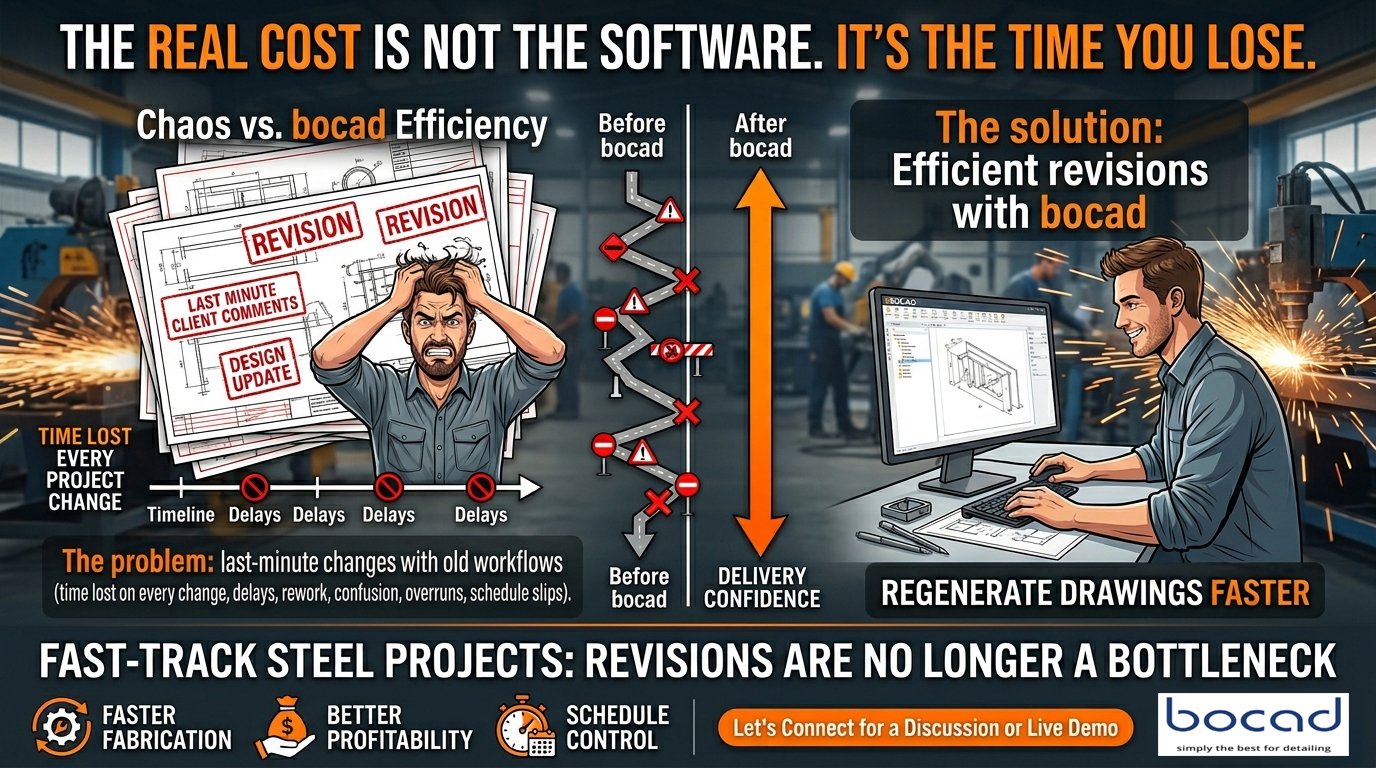
One major challenge detailing teams face today is handling revisions efficiently without disrupting the entire drawing workflow.
In real projects, revisions are unavoidable.
A client may ask for a connection change.
A consultant may revise design information.
A fabrication team may request a practical update.
A site condition may force changes.
A drawing may need to be regenerated quickly.
When these changes happen, the problem is not only the change itself. The bigger problem is how much time the team loses while updating, checking, coordinating, and regenerating drawings.
This is where Steel Detailing Productivity becomes critical.
If a team cannot manage revisions efficiently, project changes can create unnecessary rework, delays, confusion, and pressure on delivery schedules.
For many companies, the hidden cost is not visible immediately. It appears as repeated man-hours, delayed approvals, late fabrication inputs, and reduced project control.
Why Traditional Workflows Become Difficult
Many detailing teams continue with workflows that worked in the past. But today’s project environment is different.
Projects are faster.
Client expectations are higher.
Revision cycles are tighter.
Fabrication timelines are more demanding.
Coordination pressure is increasing.
In such conditions, traditional workflows may struggle when changes keep coming till fabrication.
If every change requires too much manual correction, manual checking, and repeated drawing work, the team loses valuable time. Over multiple projects, this lost time becomes a serious productivity cost.
That is why companies are not only looking at software cost anymore. They are looking at workflow efficiency, revision handling, drawing regeneration speed, and project turnaround time.
In simple terms, they are looking for better Steel Detailing Productivity.
How bocad Helps Detailing Teams Handle Change Faster
This is where bocad stands apart.
With bocad, modifications and last-minute changes can be handled in a much more practical and efficient way. This helps detailing teams regenerate drawings faster and reduce unnecessary rework during project execution.
For teams focused on Steel Detailing Productivity, bocad provides a practical way to manage project changes without disturbing the entire drawing workflow.
When changes are handled efficiently, the detailing team can respond faster. Drawings can be updated faster. Fabrication-related outputs can move forward with more confidence.
For fabricators, that directly translates into:
- Better productivity
- Faster revision handling
- Improved delivery confidence
- Better schedule control
- Reduced unnecessary rework
- Faster project turnaround
This is very important because structural steel projects do not wait for perfect conditions. Changes happen, comments arrive, and timelines continue to move.
The right detailing workflow helps teams stay ready for those changes.
bocad for Faster Approvals, Fabrication, and Delivery
In steel projects, detailing speed can influence the complete execution cycle.
When drawings are prepared and revised faster, approvals can move faster. When approvals move faster, fabrication can start with better confidence. When fabrication starts without unnecessary delay, project delivery becomes easier to control.
That is why faster detailing means more than just saving time inside the design office.
It supports:
- Faster approvals from clients and consultants
- Faster fabrication readiness
- Better coordination between detailing and fabrication teams
- Reduced waiting time during revision cycles
- Improved project turnaround
- Better profitability for fabricators
This is the real value of Steel Detailing Productivity.
It is not only about producing drawings quickly. It is about helping the entire project move forward with fewer interruptions.
Why Fabricators Should Evaluate bocad Now
Today, many fabricators and steel detailing companies are evaluating new workflows because the market is becoming more competitive.
The companies that can adapt faster have a stronger advantage.
If a detailing team can handle project changes quickly, regenerate drawings efficiently, and reduce repeated manual rework, the company can protect both time and profitability.
That is why evaluating bocad makes sense for companies that want to improve steel detailing efficiency and reduce project turnaround time.
At Sravani Infotech, in partnership with SCHULLER & Company, we are seeing increasing interest from companies that want to improve detailing efficiency and reduce project turnaround time with bocad.
For companies serious about Steel Detailing Productivity, this may be the right time to review whether the current workflow is truly supporting project speed, revision control, and delivery confidence.
bocad — Simply the Best for Detailing
bocad — Simply the best for detailing.
If your team is exploring ways to improve detailing productivity, manage revisions better, and accelerate project delivery, it may be the right time to evaluate bocad.
Project changes will always happen in structural steel.
The question is not whether changes will come.
The real question is:
How fast can your detailing workflow respond when the project changes?
With bocad, fabricators and detailing companies can move towards a more efficient workflow that supports faster revisions, reduced rework, better schedule control, and stronger project turnaround.
For companies looking to improve Steel Detailing Productivity, bocad can be a practical and powerful step forward.
Let’s connect for a discussion or live demo.