
Introduction
Choosing the right 3D CAD software is not about “which is best,” but about which fits your workflow, business model, and long-term strategy.
We’ve put together a neutral, practical comparison of ZW3D vs SolidWorks vs Inventor, focusing on licensing models, modeling approaches, interoperability, and design-to-manufacturing workflows.
In today’s manufacturing and product design environment, 3D CAD software plays a critical role in turning ideas into production-ready models. Among the widely used solutions are SolidWorks, Autodesk Inventor, and ZW3D—each serving different organizational needs, workflows, and business models.
This article provides a practical and objective comparison to help engineering and manufacturing teams understand where each platform fits best, without positioning one as a replacement for another.
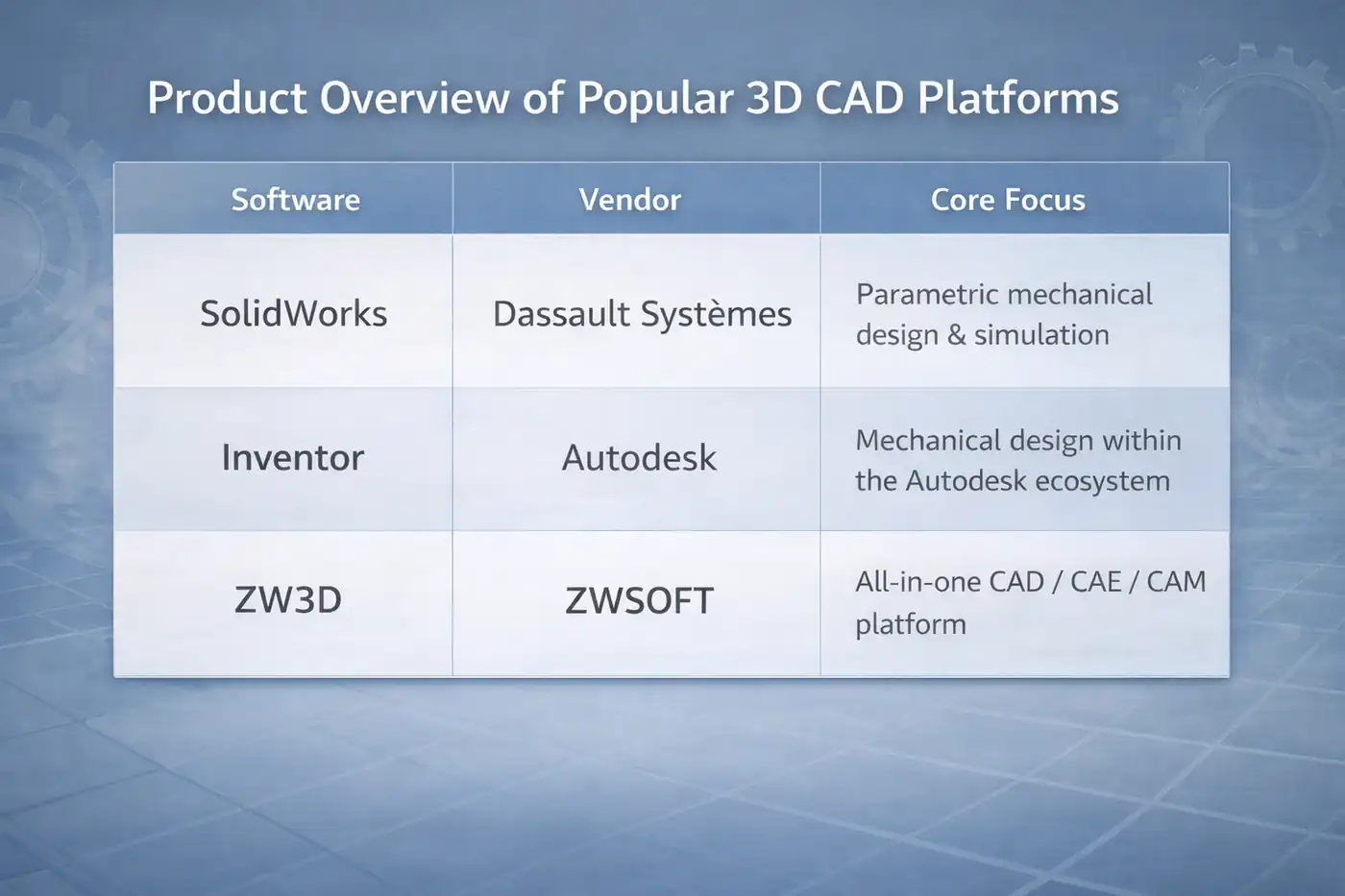
Product Overview of Popular 3D CAD Platforms
| Software | Vendor | Core Focus |
| SolidWorks | Dassault Systèmes | Parametric mechanical design & simulation |
| Inventor | Autodesk | Mechanical design within the Autodesk ecosystem |
| ZW3D | ZWSOFT | All-in-one CAD / CAE / CAM platform |
Licensing & Ownership Models in 3D CAD Software
| Aspect | SolidWorks | Inventor | ZW3D |
| License type | Subscription-based | Subscription-based | Perpetual (one-time purchase) |
| Ownership | Active during subscription | Active during subscription | Permanent ownership |
| Upgrade flexibility | Subscription renewal | Subscription renewal | Optional upgrade plans |
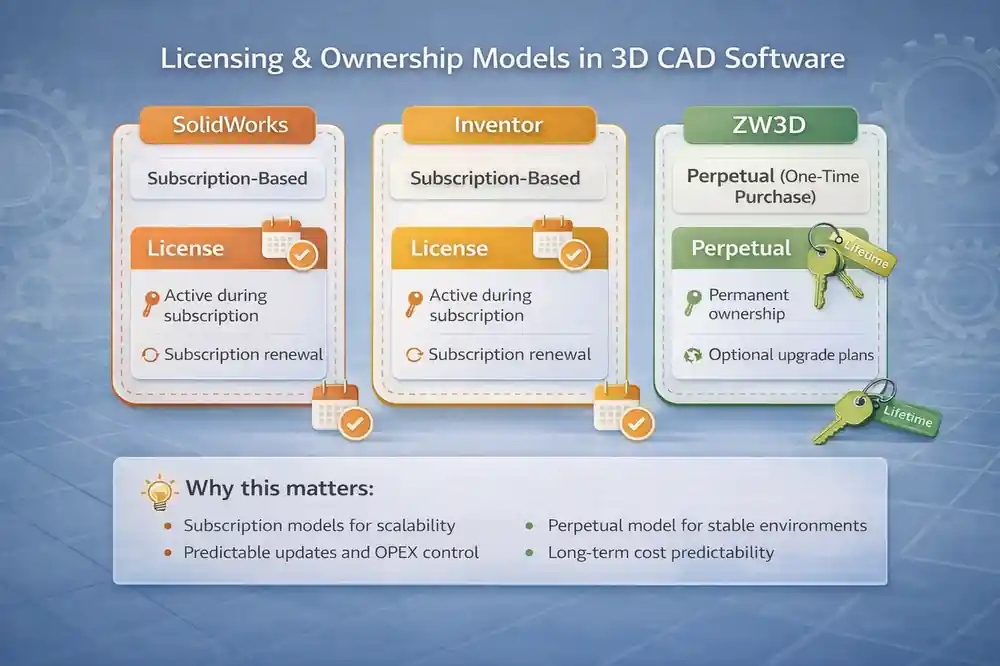
Why this matters:
Some organizations prefer subscription models for scalability and predictable updates, while others value long-term cost predictability and ownership, especially in stable or manufacturing-focused environments.
3D Modeling Approaches & Core Design Capabilities
| Capability | SolidWorks | Inventor | ZW3D |
| Parametric modeling | Yes | Yes | Yes |
| Direct modeling | Limited | Limited | Yes (strong focus) |
| Hybrid modeling (parametric + direct) | Partial | Partial | Native & seamless |
| Assembly design | Advanced | Advanced | Advanced |
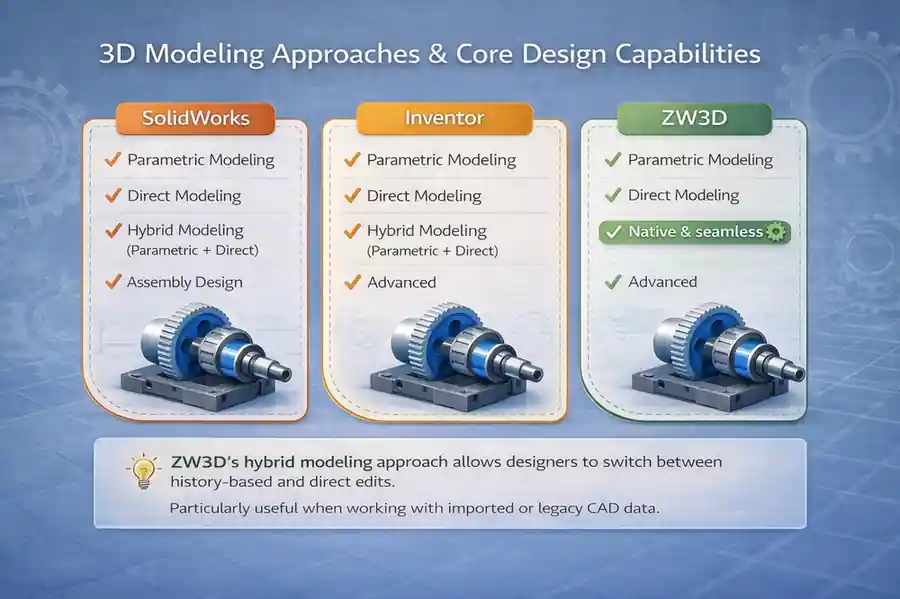
ZW3D’s hybrid modeling approach allows designers to switch between history-based and direct edits, which can be particularly useful when working with imported or legacy CAD data.
Interoperability and Multi-CAD File Compatibility
| Area | SolidWorks | Inventor | ZW3D |
| Native file handling | Strong within ecosystem | Strong within Autodesk | Broad multi-CAD support |
| Import/export formats | Industry standard | Industry standard | 25+ CAD formats supported |
| Neutral formats (STEP, IGES, Parasolid) | Yes | Yes | Yes |
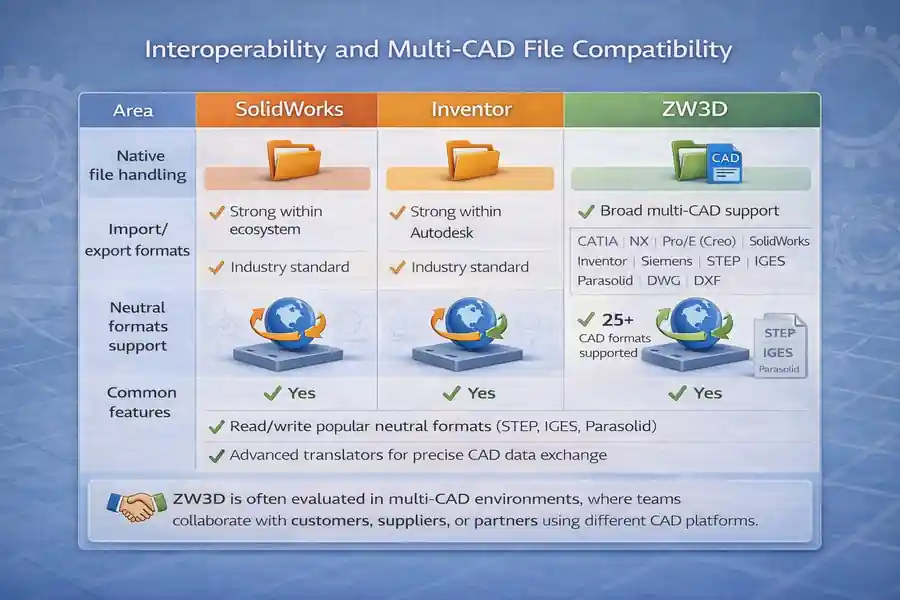
ZW3D is often evaluated in multi-CAD environments, where teams collaborate with customers, suppliers, or partners using different CAD platforms.
Integrated CAD, CAE & CAM Workflow Overview
| Feature Area | SolidWorks | Inventor | ZW3D |
| Core CAD | Yes | Yes | Yes |
| Built-in simulation | Add-ons / modules | Add-ons / modules | Integrated options available |
| CAM integration | External / partner tools | External / partner tools | Native CAM environment |
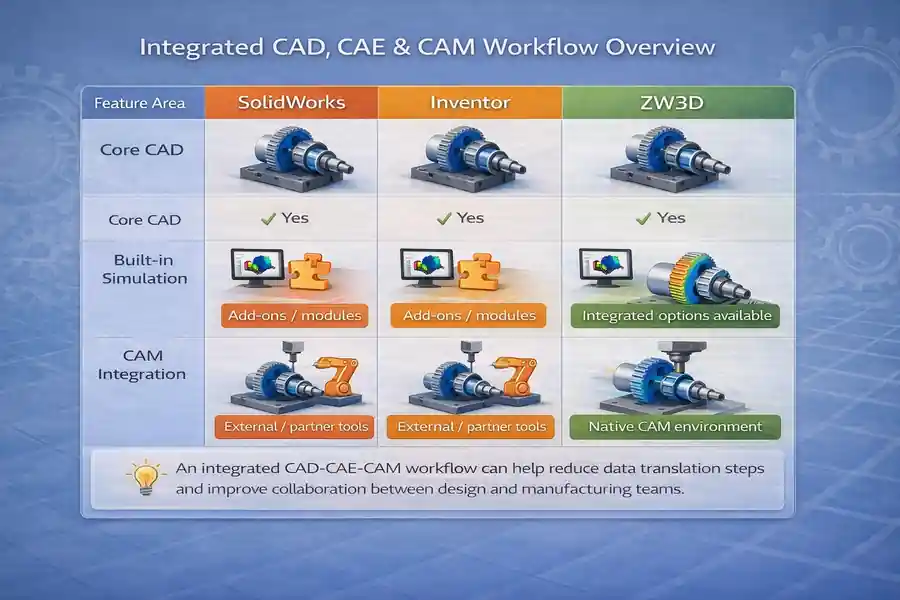
An integrated CAD-CAE-CAM workflow can help reduce data translation steps and improve collaboration between design and manufacturing teams.
Typical Usage Scenarios
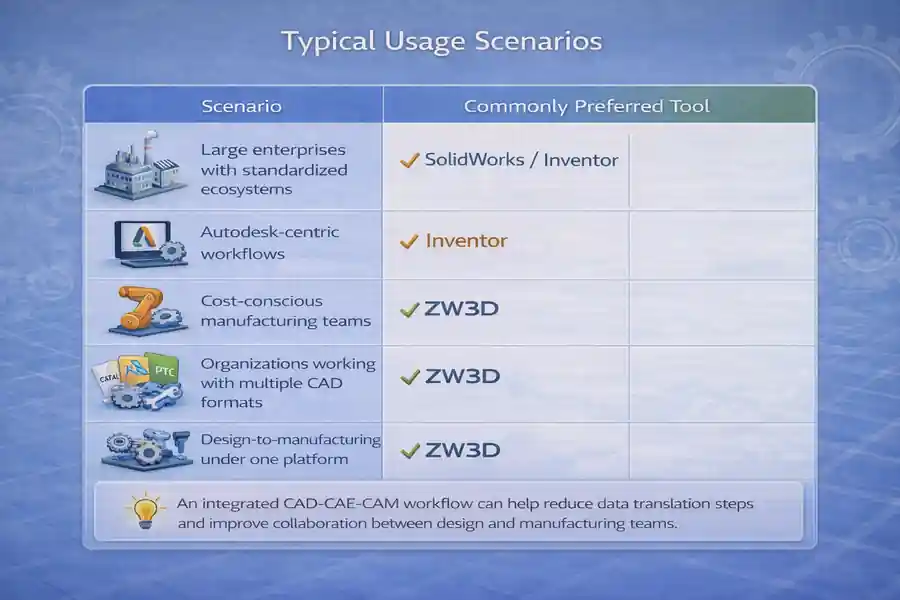
| Scenario | Commonly Preferred Tool |
| Large enterprises with standardized ecosystems | SolidWorks / Inventor |
| Autodesk-centric workflows | Inventor |
| Cost-conscious manufacturing teams | ZW3D |
| Organizations working with multiple CAD formats | ZW3D |
| Design-to-manufacturing under one platform | ZW3D |
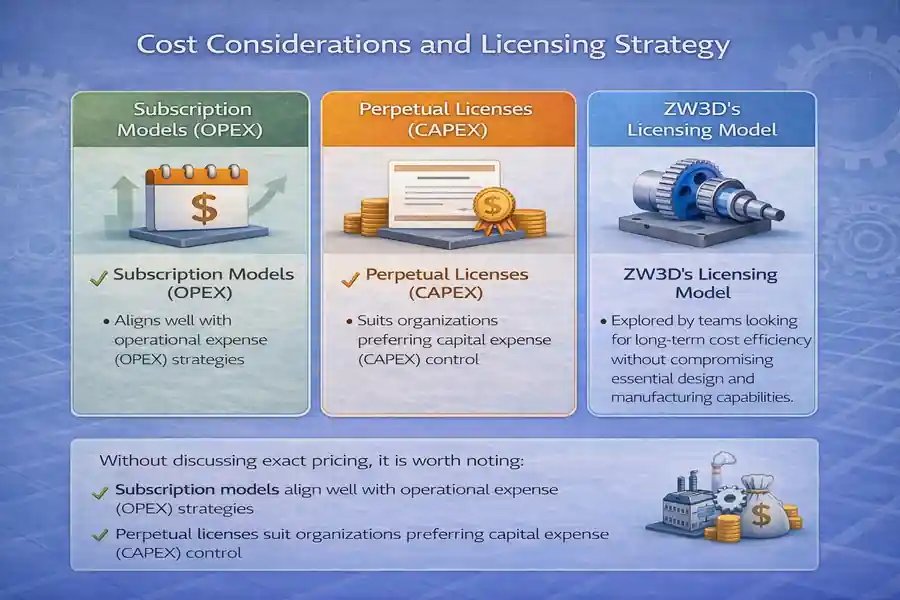
Cost Considerations and Licensing Strategy (High-level)
Without discussing exact pricing, it is worth noting:
- Subscription models align well with operational expense (OPEX) strategies
- Perpetual licenses suit organizations preferring capital expense (CAPEX) control
- ZW3D’s licensing model is often explored by teams looking for long-term cost efficiency without compromising essential design and manufacturing capabilities.
Final Thoughts
Each of the platforms discussed—SolidWorks, Inventor, and ZW3D—are capable and well-established in the industry. The right choice depends on:
- Business model and budget strategy
- Team size and skill set
- Existing software ecosystem
- Collaboration requirements
- Manufacturing and downstream needs
ZW3D continues to gain attention as a practical, integrated 3D CAD/CAE/CAM solution, particularly for organizations seeking flexibility, interoperability, and predictable ownership.
Want to know more about ZW3D?
If you’d like to explore how ZW3D fits into your design or manufacturing workflow, feel free to reach out to us.
📞 +91 9703117055 | 99861 44241
📧 info@sravaniinfotech.com
Related Articles
- bocad 2026: Future-Ready BIM & Steel Detailing Software
- bocad & AVEVA integration: 5 Powerful Workflow Gains
- SketchUp: Why Designers Love It in 2025 – Accurate & Modern
External Reference
- Dassault Systèmes – SolidWorks Overview
- Autodesk – Inventor Product Overview
- ZWSOFT – ZW3D Official Product Page
FAQ on ZW3D vs SolidWorks vs Inventor
1. In ZW3D vs SolidWorks vs Inventor, which is better for cost-conscious manufacturing teams?
ZW3D is often preferred in ZW3D vs SolidWorks vs Inventor comparisons when long-term cost control is important. Its perpetual licensing and integrated workflow reduce recurring expenses without limiting core design capabilities.
Perpetual license ownership
Lower long-term operational cost
No forced subscription renewals
Suitable for stable manufacturing environments
2. How does licensing differ in ZW3D vs SolidWorks vs Inventor?
Licensing is a key differentiator. While SolidWorks and Inventor rely on subscriptions, ZW3D offers permanent ownership with optional upgrades.
Subscription model (SolidWorks, Inventor)
Perpetual license option (ZW3D)
OPEX vs CAPEX flexibility
Predictable long-term budgeting with ZW3D
3. In ZW3D vs SolidWorks vs Inventor, which supports hybrid modeling best?
ZW3D stands out for its native hybrid modeling. It allows seamless switching between parametric and direct edits within the same model.
Parametric + direct modeling together
No rebuild-heavy workflows
Easier handling of design changes
Efficient editing of imported models
4. Why is ZW3D favored in multi-CAD environments compared to ZW3D vs SolidWorks vs Inventor?
In comparision , ZW3D is commonly evaluated for multi-CAD collaboration. Its broad file compatibility simplifies supplier and customer coordination.
Supports 25+ CAD formats
Strong neutral format handling
Reduced translation errors
Ideal for supplier-driven projects
5. Which platform offers better design-to-manufacturing flow in ZW3D vs SolidWorks vs Inventor?
ZW3D provides a more unified design-to-manufacturing experience scenarios due to its native CAD-CAE-CAM environment.
Single platform workflow
Native CAM integration
Fewer data handoffs
Faster manufacturing readiness
6. How does CAM integration differ in ZW3D vs SolidWorks vs Inventor?
CAM integration is a practical advantage for ZW3D . ZW3D includes native CAM, while others depend on partner tools.
Built-in CAM in ZW3D
External CAM add-ons in others
Reduced software complexity
Better shop-floor continuity
7. Is ZW3D suitable for organizations avoiding subscription dependency in ZW3D vs SolidWorks vs Inventor?
Yes, ZW3D is often chosen evaluations by organizations that prefer ownership over recurring subscriptions.
One-time license purchase
Optional upgrade paths
No forced renewals
Long-term operational stability
8. In ZW3D vs SolidWorks vs Inventor, which handles imported CAD data better?
ZW3D is particularly effective when working with imported or legacy CAD data due to its strong direct and hybrid modeling tools.
Direct editing without full rebuild
Faster change implementation
Less dependency on feature history
Ideal for vendor-supplied models
9. How does interoperability compare in ZW3D vs SolidWorks vs Inventor?
Interoperability is a major strength for ZW3D, especially in mixed-software environments.
Broad multi-CAD support
Neutral formats like STEP, IGES, Parasolid
Stable data exchange
Better cross-team collaboration
10. Which is better for SMEs in ZW3D vs SolidWorks vs Inventor?
SMEs often explore ZW3D due to its balance of capability, ownership, and cost efficiency.
Lower entry and ownership cost
Integrated feature set
Reduced dependency on add-ons
Easier long-term planning
11. In ZW3D vs SolidWorks vs Inventor, which supports integrated simulation more practically?
ZW3D offers integrated simulation options , while others typically require separate modules.
Integrated analysis options
Reduced add-on dependency
Faster design validation
Streamlined engineering workflow
12. How does assembly design compare in ZW3D vs SolidWorks vs Inventor?
All three platforms support advanced assembly design, but ZW3D adds flexibility in ZW3D vs SolidWorks vs Inventor through hybrid editing within assemblies.
Advanced assembly handling
Direct edits at assembly level
Better handling of imported parts
Efficient change management
13. Why do manufacturers consider ZW3D in ZW3D vs SolidWorks vs Inventor evaluations?
Manufacturers often consider ZW3D for its integrated manufacturing-focused workflow.
Native CAD-CAM environment
Reduced rework
Faster production transition
Better cost predictability
14. Is ZW3D suitable for long-term CAD investments in ZW3D vs SolidWorks vs Inventor?
ZW3D is commonly viewed as a long-term investment due to its ownership model and upgrade flexibility.
Permanent license ownership
Optional upgrades
Lower lifecycle cost
Stable toolset for mature processes
15. How does ZW3D support design flexibility in ZW3D vs SolidWorks vs Inventor?
Design flexibility is a key advantage for ZW3D, especially when frequent changes are required.
Hybrid modeling workflow
Fewer feature rebuild issues
Faster design iterations
Better response to late changes
16. In ZW3D vs SolidWorks vs Inventor, which is better for supplier collaboration?
ZW3D is often preferred when collaborating with suppliers using different CAD systems.
Multi-format file compatibility
Stable data translation
Reduced dependency on native formats
Smoother supplier integration
17. How does ZW3D fit manufacturing-focused organizations in ZW3D vs SolidWorks vs Inventor?
ZW3D aligns well with manufacturing-focused organizations due to its integrated design-to-production workflow.
CAD, CAE, and CAM in one platform
Fewer software transitions
Faster production readiness
Simplified engineering stack
18. Is ZW3D easier to maintain operationally in ZW3D vs SolidWorks vs Inventor?
Operational simplicity is a common reason teams choose ZW3D.
Fewer add-ons to manage
Predictable licensing
Lower IT overhead
Simplified training paths
19. In ZW3D vs SolidWorks vs Inventor, which supports CAPEX-based budgeting?
ZW3D fits CAPEX-based budgeting strategies better due to its perpetual licensing option.
One-time investment model
Long-term ownership
Reduced recurring costs
Better financial planning control
20. Why is ZW3D gaining attention in ZW3D vs SolidWorks vs Inventor comparisons?
ZW3D is gaining attention for offering a balanced combination of flexibility, interoperability, and ownership.
Integrated CAD-CAE-CAM workflow
Strong hybrid modeling
Multi-CAD compatibility
Predictable long-term value
I am sure this article has touched all the internet people, its really really fastidious paragraph on building up new web site.
Pesomaxfun, eh? Well, I tried it. Found something interesting about it. You go see for yourself at pesomaxfun and hit me up with what you think.
Noho NYC – something related to North of Houston Street. I’m from NYC. Gonna check it to find some local gems! Check it out yourself: nohonyc
Yo, m88a2hercules is where it’s at! Seriously, if you’re looking for some action, this is the place. I’ve been hooked for weeks now. Worth a look m88a2hercules.
metoprolol xl
metoprolol xl
lasix pill
lasix pill
antibiotics for bronchitis
antibiotics for bronchitis
allopurinol for gout treatment
allopurinol for gout treatment
monodox
monodox
metoprolol tartrate 50 mg
metoprolol tartrate 50 mg